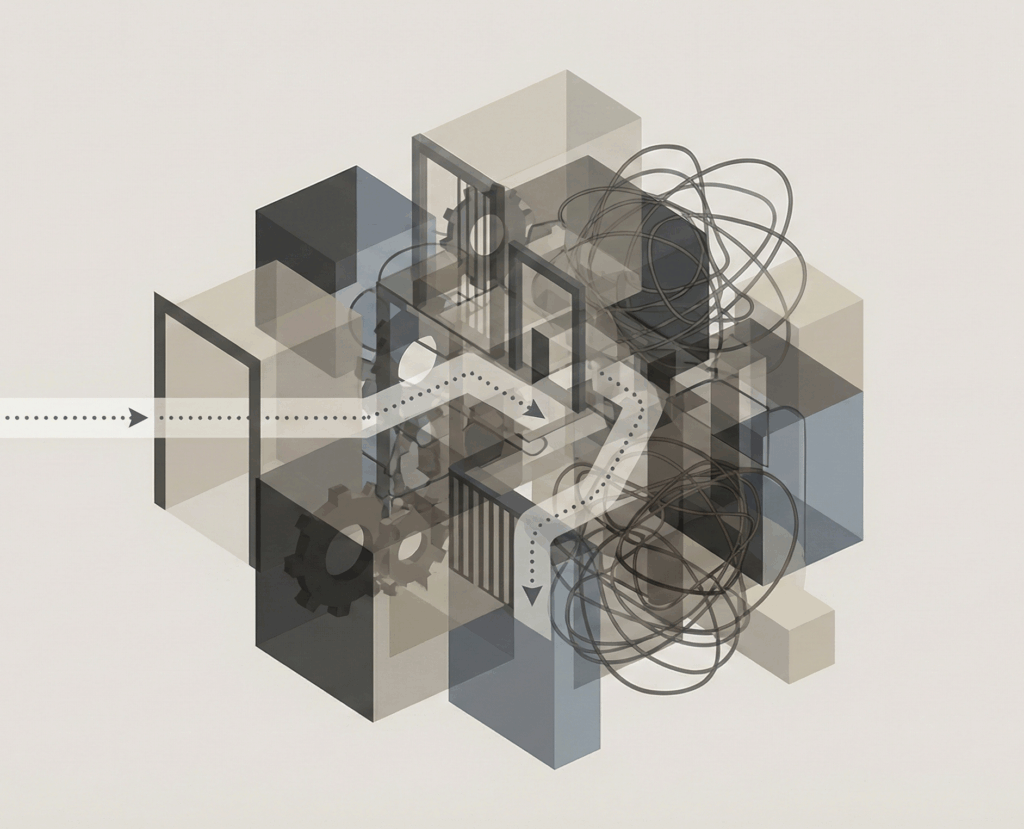
Many researchers today are asking the same uneasy question: is the PhD system broken?
This concern is not coming only from critics outside academia. It is increasingly voiced by PhD students themselves, early-career researchers, and even faculty members who sense that something in the system no longer aligns with reality.
The short answer is this: the problem is not that research is too hard. It is that research training is poorly systematized.
Most PhD programs still rely on an implicit apprenticeship model that assumes students will “pick up” research judgment over time. In today’s environment of limited supervision, faster publishing cycles, and higher competition, this model often fails even strong students.
Once you see that distinction clearly, the confusion around PhDs begins to make sense.
⸻
Is the PhD system broken?
Short answer: yes, but not because research is too hard.
The deeper problem is that research training is poorly systematized. Most PhD programs still rely on an implicit apprenticeship model that assumes students will “pick up” research judgment over time. In today’s environment of limited supervision, faster publishing cycles, and higher competition, this model often fails even strong students.
The core criticisms of the PhD system tend to be familiar and well-rehearsed:
• There are more PhDs than academic jobs
• Completion rates are low and time-to-degree is long
• Many students feel isolated, anxious, or stuck
• Publishing feels opaque and unpredictable
• Career preparation outside academia is weak
These are indeed real issues. But focusing only on “too many PhDs” or “bad job markets” misses the deeper structural problem.
The core problem is that research training still relies on an implicit apprenticeship model that assumes students will “pick up” research judgment over time. This PhD model was designed for a different era, when academic careers were expanding, mentorship was abundant, and publishing norms were slower and less competitive. Those conditions no longer hold today.
⸻
Why do so many PhD students struggle, even strong ones?
One of the most striking patterns in doctoral education is this:
Highly capable students often stall not because they lack ability, but because they lack structure.
Common experiences include:
• working hard but feeling directionless
• reading endlessly without converging on a contribution
• revising drafts repeatedly without clear feedback
• waiting months for guidance that never fully arrives
This isn’t a personal failure. It’s a systems failure.
Most PhD programs still rely on an implicit apprenticeship model:
• Students are expected to “absorb” how research works by watching others
• Key decisions (topic choice, scope, positioning, journal strategy) are learned informally
• Progress depends heavily on the availability and style of one supervisor
When supervision works well, students thrive. When it doesn’t, students drift, often silently. Not everyone wins the supervisor lottery.
Why do PhD students get so little supervision today?
In many programs, supervision has been compressed to surprisingly small amounts of time, sometimes as little as one hour per month.
That leaves students making high-stakes research decisions largely on their own, without having been explicitly trained how to make them.
This reduction in supervision is not usually the result of neglect or indifference. It reflects broader structural shifts in academia.
Faculty supervise more students than in the past, face stronger incentives to prioritise grant-funded research and publication, and are often evaluated more on research output than on mentoring. At the same time, student-faculty research interests do not always align closely, limiting the depth of guidance that is feasible in practice.
The result is a system in which supervision is expected to compensate for a lack of formal training, even as the conditions that once made that possible have eroded.
⸻
Is the real problem “too many PhDs” — or poor training design?
This is the wrong question framed the right way.
The issue is not simply the number of PhDs being produced.
It’s that research competence is treated as tacit knowledge rather than an explicit skillset.
In many programs:
• Topic selection is intuitive rather than strategic
• Literature reviews are descriptive rather than synthetic
• Methods are taught, but research judgment is not (by research judgment we mean the ability to decide what matters, what is feasible, and what counts as a contribution)
• Publishing is treated as an outcome, not a trainable process
As a result, students are often evaluated on outputs they were never systematically taught how to produce.
⸻
What skills does a PhD often fail to teach explicitly?
Across academia, policy, industry, and consulting, successful researchers share a small set of core capabilities:
• Problem framing: identifying questions that matter and are feasible
• Evidence mapping: understanding what is known, contested, or missing
• Synthesis: extracting patterns across many studies
• Clear writing: communicating findings efficiently and persuasively
• Execution: moving from idea → draft → submission without paralysis
These skills are learnable, but they are rarely taught end-to-end in doctoral training. As AI tools accelerate execution, these human judgement-level skills become more important.
⸻
What’s the alternative to the traditional PhD model?
An increasing number of researchers are discovering that progress accelerates when research is treated as a system, not a mystery.
That means:
• making topic selection explicit and testable
• using structured frameworks for reviews and synthesis
• breaking large projects into reproducible stages
• shortening feedback loops
• optimizing for completion rather than perfection
When this happens, something interesting occurs: Publishing stops feeling like a referendum on intelligence, and starts feeling like a process. This doesn’t eliminate the need for supervision, creativity, or deep thinking. It simply removes unnecessary opacity.
⸻
Does this mean the PhD should be abolished?
No. The PhD remains valuable for:
• deep disciplinary immersion
• original knowledge production
• careers that genuinely require it
But it no longer functions well as a universal training model for research competence.
The future is likely hybrid:
• formal doctoral programs for those who need them
• parallel, systematized research training for those who want to publish, contribute, and move forward without years of drift
⸻
Is leaving a PhD a failure?
Many people interpret leaving a PhD as failure. In reality, it’s often a rational response to misaligned incentives and unclear training. Leaving does not mean:
• you aren’t capable of research
• you lack discipline
• you couldn’t have succeeded
It often means:
• the system did not provide the structure you needed
• your goals changed
• or the cost-benefit no longer made sense
Research ability is not owned by institutions.
⸻
The deeper reframing: what actually needs to change
The most productive way to think about the current moment is this: The PhD isn’t broken because research is too difficult. It’s strained because research training hasn’t kept pace with how knowledge is produced today. Once research skills are taught explicitly, rather than assumed, outcomes improve dramatically.
That’s not a rebellion against academia. It’s an evolution of it.
⸻
Why this page exists
This guide is meant to be a starting point, not a verdict.
If you’re:
• questioning your PhD,
• reacting to stories of others leaving,
• or trying to understand why capable people get stuck,
the answer is rarely individual weakness. It’s almost always structural.
How we approach research training