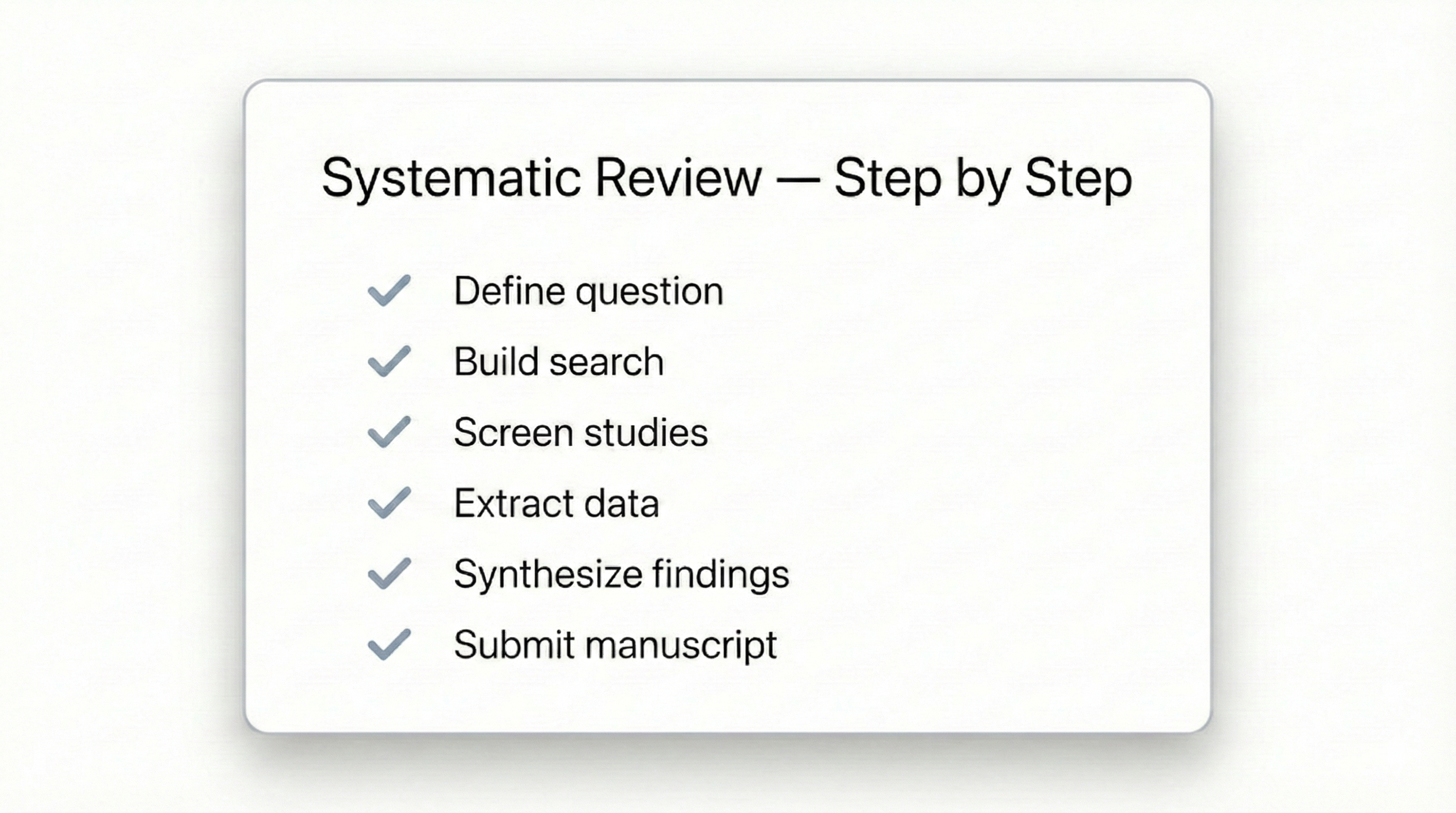
Systematic reviews are often described as “straightforward but time-consuming.” In practice, most delays come from unclear decisions, false starts, and uncertainty about what to do next. This guide outlines how systematic reviews are actually completed in practice, from initial question formulation to journal submission.
Below is a realistic overview of how systematic reviews are actually completed, from idea to submission.
Step 1: Clarifying the Research Question
Successful reviews start with a tightly scoped research question, often using frameworks such as PICO. Vague questions lead to unmanageable searches or inconclusive results.
Step 2: Designing a Reproducible Search Strategy
This includes:
- selecting appropriate databases
- defining inclusion and exclusion criteria
- testing for missing key papers
At this stage, many reviews fail due to overly broad or overly narrow searches.
Step 3: Screening and Study Selection
Screening requires consistent decision-making and careful documentation (e.g. PRISMA). Software can assist, but human judgment is essential.
Unlike review software, which supports individual tasks such as screening or data management, successful systematic reviews depend on sequencing methodological decisions correctly across the entire process.
Step 4: Data Extraction and Synthesis
This is where a review becomes more than a summary. Researchers must extract comparable information and identify patterns across studies, rather than describing papers one by one.
Step 5: Writing and Structuring the Review
High-quality reviews follow a clear structure aligned with journal expectations. Writing usually becomes easier after proper synthesis, not before.
Step 6: Journal Selection, Submission, and Revision
Choosing an appropriate journal, responding to reviewers, and resubmitting are integral parts of the process. Many reviews stall at this stage without guidance.
Where Researchers Get Stuck
Most problems arise not from lack of intelligence, but from:
- unclear scope
- premature writing
- treating the review as a reading task rather than an execution project
Key takeaway
Publishing a systematic review is less about software and more about sequencing decisions correctly. Tools support the process, but they do not replace a structured workflow.