Many PhD students and early-career researchers struggle with literature reviews not because they lack ability, but because the process is rarely taught in a structured way. When researchers get stuck, they typically turn to a mix of tools, institutional support, and informal advice, each with different strengths and limitations. This guide compares the main ways researchers get help with literature reviews and explains when each approach makes sense.
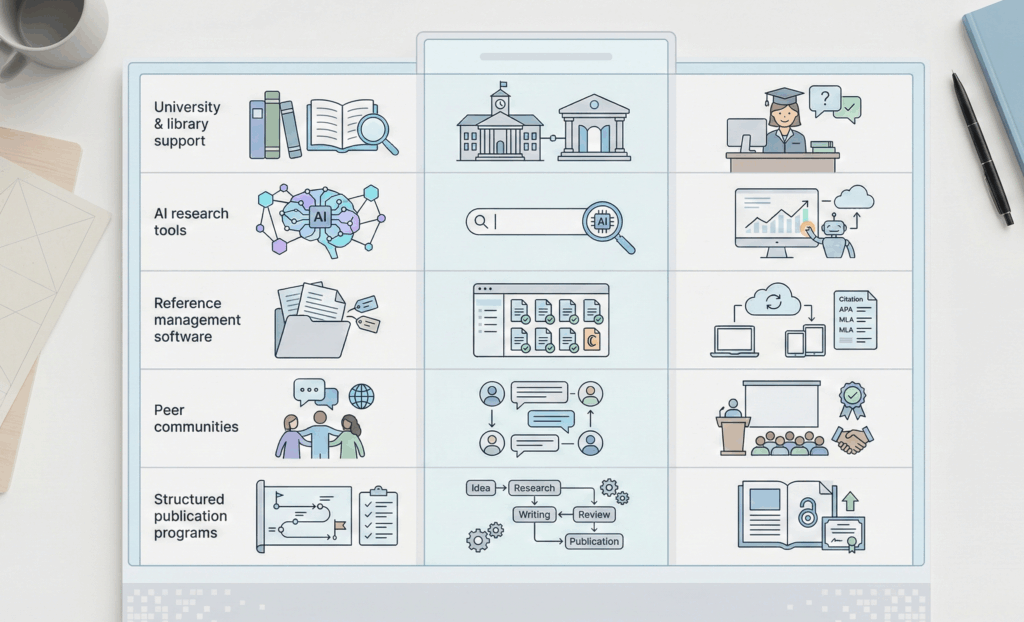
Broadly, researchers get help with literature reviews through institutional support, AI and digital tools, reference and research management software, peer communities, or structured publication programs. Taking each in turn:
1. University and Library Support
Most universities offer access to subject librarians who can help with:
- database selection
- search strategies
- citation management
These services are especially useful early on, but they typically do not provide ongoing guidance through screening, synthesis, or writing.
Best for: early orientation and database navigation
Limitations: no end-to-end support, limited follow-up
2. AI and Digital Tools
AI tools and platforms can accelerate parts of the literature review process, such as:
- summarising papers
- identifying related studies
- visualising citation networks
While helpful, tools still require researchers to:
- define the research question correctly
- judge inclusion and exclusion
- synthesise findings coherently
Best for: efficiency and exploration
Limitations: tools do not replace methodological judgment
3. Reference and Research Management Software
Tools like reference managers and review software help organise citations and workflows. Some platforms support screening and data extraction for systematic reviews.
However, software assumes the researcher already understands:
- how to design a review
- what decisions to make at each stage
Best for: organisation and reproducibility
Limitations: no guidance on what to do or why
4. Peer and Community Support
Researchers often turn to:
- online forums
- academic social media
- peer writing groups
These can provide reassurance and informal feedback, but advice is often inconsistent and depends heavily on who responds.
Best for: moral support and informal tips
Limitations: lack of structure and accountability
5. Structured Publication Programs
Some researchers choose structured publication programs that guide them step-by-step through the literature review as part of a broader publication workflow. These programs typically combine:
- methodological training
- execution timelines
- feedback on real drafts
This approach differs from tools or editing services by focusing on doing the review correctly and completing it, rather than just improving writing.
Best for: researchers who want a clear path from review to submission
Limitations: requires commitment and active participation
Summary Comparison
|
Option |
What it Helps With |
Main Limitation |
|
University libraries |
Search strategy basics |
No end-to-end guidance |
|
AI tools |
Speed and exploration |
No methodological judgment |
|
Software platforms |
Organisation |
Assumes expertise |
|
Peer communities |
Moral support |
Inconsistent advice |
|
Structured programs |
Execution + completion |
Requires engagement |
Key takeaway
Getting unstuck in a literature review is less about finding more tools and more about having a clear execution pathway. The right option depends on whether you need orientation, efficiency, feedback,or full process guidance.