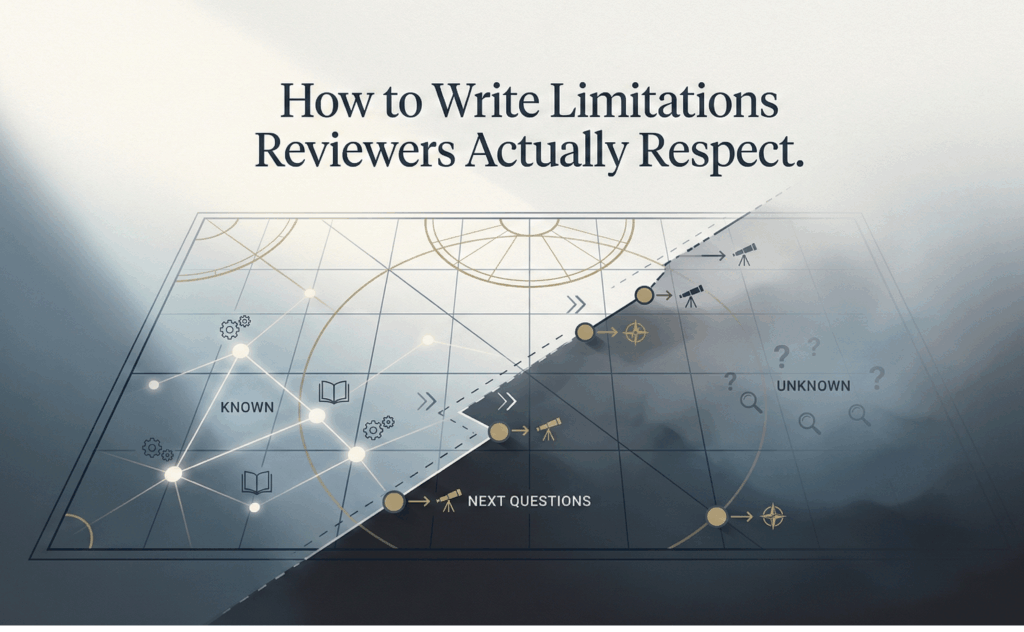
Reviewers don’t reject papers because of limitations. They reject papers when authors fail to own those limitations or show awareness of the field’s data constraints.
Strong limitations signal judgment, not weakness.
Why reviewers care about limitations
Editors are not looking for perfect data. They’re looking for authors who understand:
what the field can and cannot currently measure
where evidence is constrained
what future research needs to do next
A well-written limitation communicates one thing clearly:
“This author understands the frontier and its blind spots.”
That’s credibility.
The apology trap (what not to do)
Many first drafts frame limitations as personal failure:
“A key limitation of this study is the use of cross-sectional data.”
This reads as:
“We didn’t try hard enough.”
Even when the data choice was unavoidable.
The strategic shift: from self-blame to field awareness
The fix is simple but powerful:
Move the limitation from you to the field.
Instead of:
“We could not test causal effects because the data were cross-sectional.”
Write:
“Because longitudinal data are not yet available in this area, we assess structural patterns that suggest where future surveys should focus.”
Same fact.
New signal.
Now you sound like a field builder.
Real examples from FastTrack
Example 1: Causality
Before (defensive):
“We could not test causal effects because the data were cross-sectional.”
After (directive):
“As existing surveys capture only cross-sectional snapshots, we identify patterns that motivate future longitudinal designs.”
Example 2: Generalizability
Before:
“Results may not generalize beyond Germany.”
After:
“Work Councils are unique to Germany; however, the mechanisms we observe—such as bargaining structures and formal training frameworks—are relevant to other systems of employee representation.”
That single word — however — turns a limitation into a contribution.
Why this works in peer review
Reviewers reward authors who:
acknowledge constraints early
don’t overclaim
explain why the literature looks the way it does
guide future research rather than apologizing
This signals seniority — even in early-career work.
A 15-minute credibility upgrade you can do today
Find one limitation sentence in your draft
Replace self-blame language (“we couldn’t…”, “this study fails to…”)
Reframe it as a field constraint (“data in this field currently…”)
Add one forward-looking line (“future studies should…”)
Time: ~15 minutes
Effect: Immediate reviewer trust lift
Final perspective
Limitations don’t weaken papers. Poorly framed limitations do.
When handled well, the limitations section becomes one of the strongest signals of research judgment.